
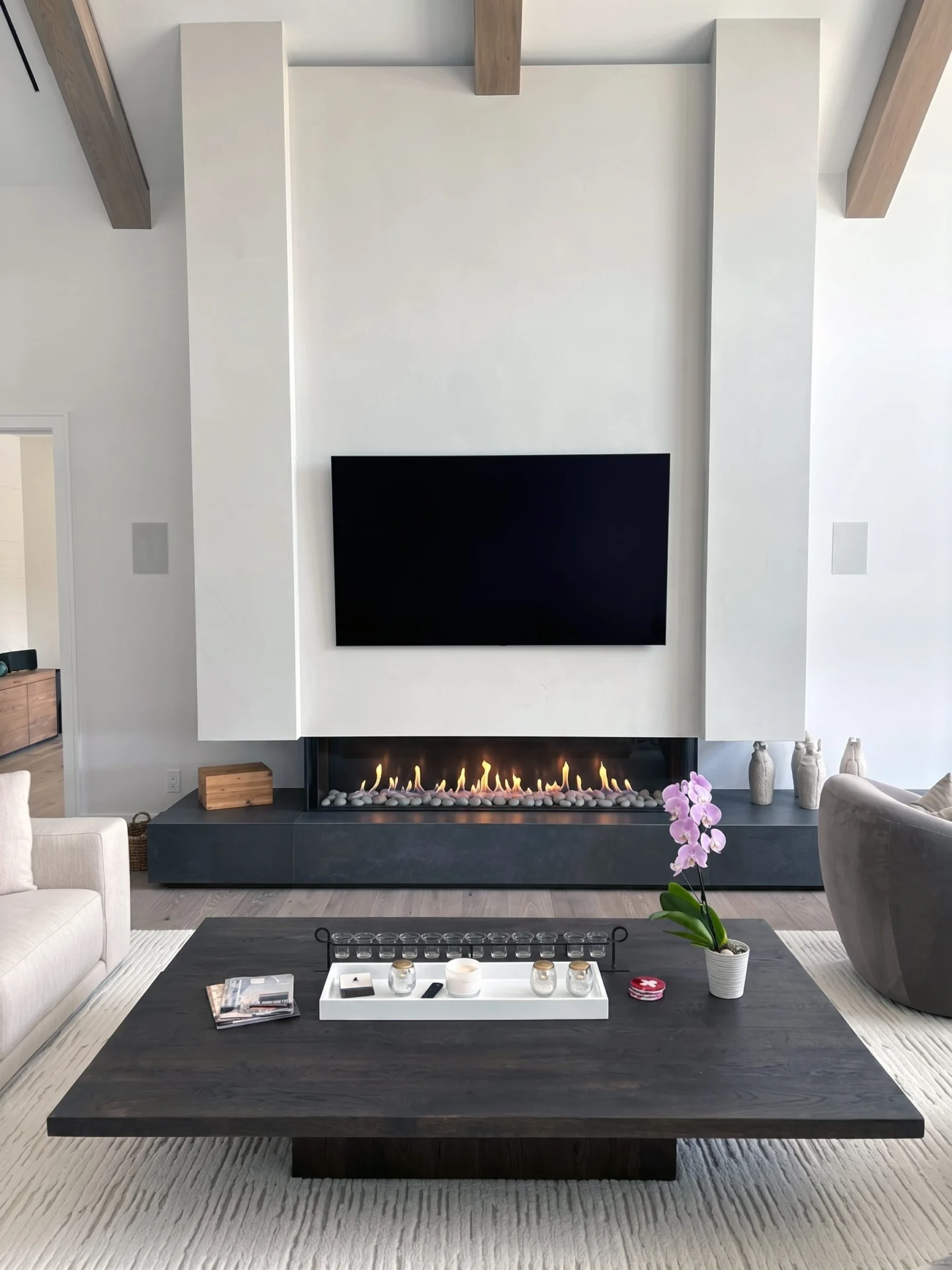
What makes a corner fireplace different?
Most fireplaces are specified flat against a wall: one direction of flame, one focal point, fixed to one area of the room.
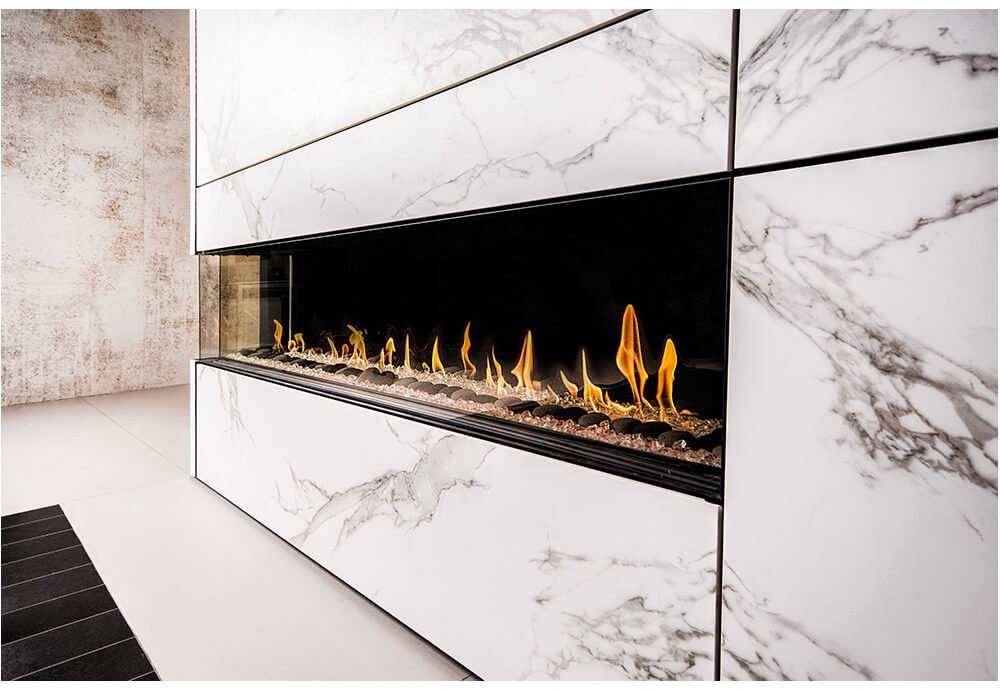
Flare’s frameless linear gas corner fireplaces change that by wrapping a single continuous flame across two or more open glass faces. The fire bridges two adjoining walls, marks the handoff between zones, and makes what used to be dead corner space the design centerpiece of the room.
Whether the project is a modern residence, a hotel lobby, or a high-end commercial interior, a corner fireplace creates a sightline dynamic a flat fireplace simply cannot match.
A flat fireplace serves one seating area. A corner fireplace earns its place in several rooms at once.
The four corner configurations
All four share the same frameless design language: no visible metal frame, no surround clutter, just fire and glass. They differ in how many faces the flame wraps and where the unit sits in the room: two-sided in the Left and Right Corner, three-sided in the Double Corner and Room Definer. Each comes in multiple widths, three glass heights, and a choice of media: black diamonds, glowing embers, or driftwood logs.
Left Corner
Glass faces front and right; installs in the left corner of the room.
VIEW MODELS →Right Corner
The mirror image. Glass faces front and left; installs in the right corner.
VIEW MODELS →Double Corner: 3-Sided (Bay)
A three-sided fireplace. Glass wraps the full corner bay, with flame visible on three sides at once.
VIEW MODELS →Room Definer (Peninsula)
Freestanding, projecting into the room with flame visible from three sides.
VIEW MODELS →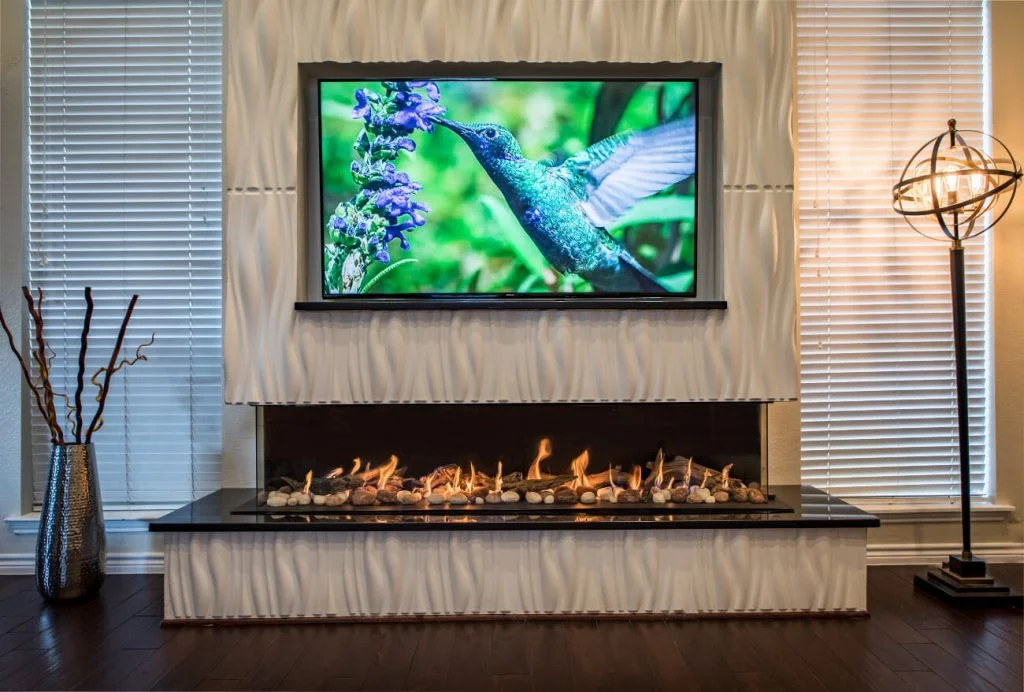
Left and Right Corner
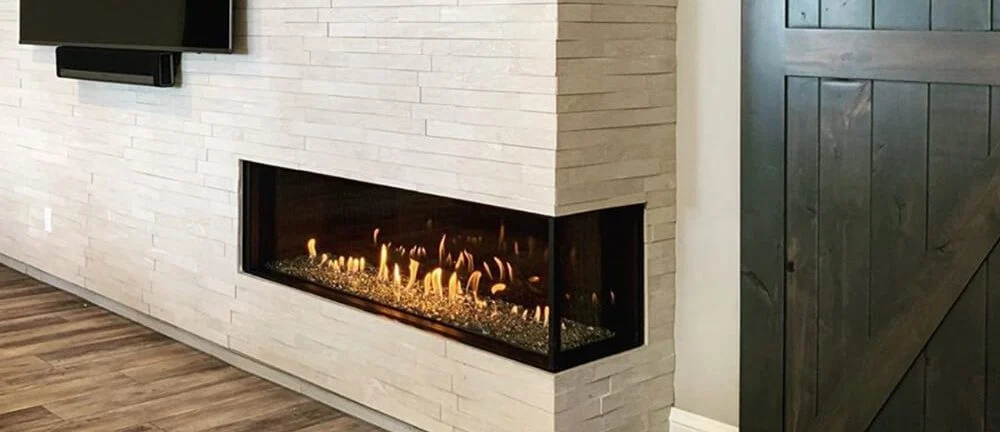
The Left Corner installs in the left corner with glass facing forward and to the right; the Right Corner is its mirror. Both open the flame across two adjoining faces, and because Flare builds them to identical specifications they can be paired in a symmetric room to frame a central seating zone. On the Celebrity IOU project with Howie Mandel, a Left Corner anchored a luxury entertaining space; the Cosentino collaboration used an 80-inch Left Corner clad in large-format stone for a monolithic, frame-free fireplace wall.
Double Corner: 3-Sided (Bay)
The Double Corner is Flare’s three-sided fireplace: glass wraps across three faces, front, left, and right, so the flame reads from every angle and becomes the structural anchor of a large room. The Frank Wright Double Corner shows it at full scale: an 80-inch unit with 24-inch glass, visible at once from three zones.
Room Definer (Peninsula)
The Room Definer is freestanding, projecting into the room with glass on three sides. Rather than fitting into a corner, it uses fire as a boundary, separating living from dining, or sleeping from sitting, without building a wall or blocking light. It is Flare’s tool for defining zones in a fully open plan.
Why architects choose corner fireplaces
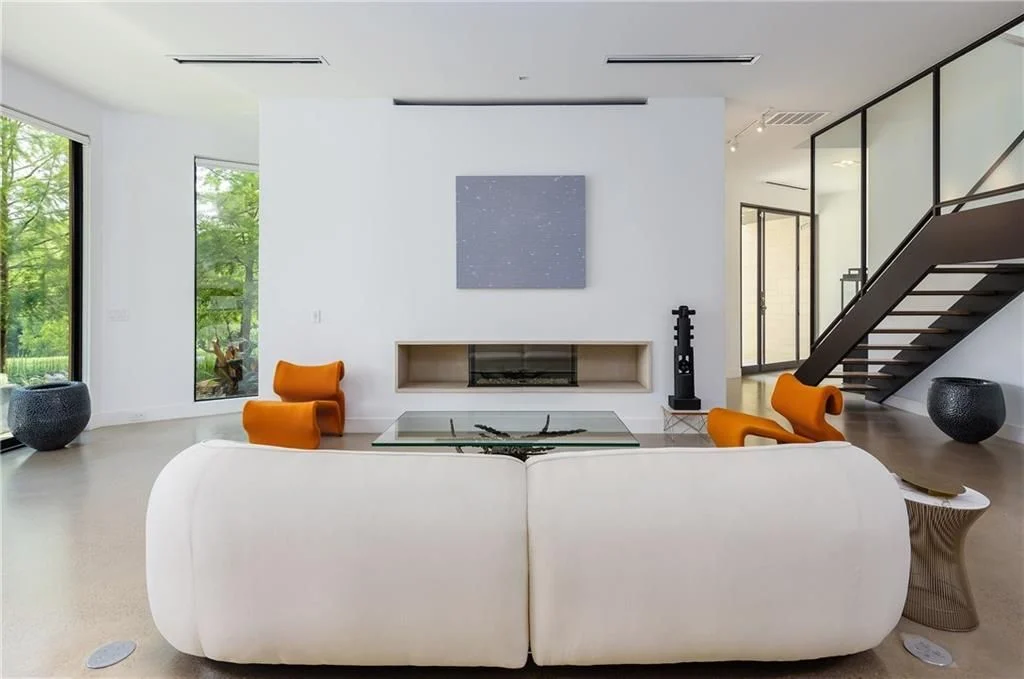
Design teams reach for a corner configuration when a single flat wall of flame cannot do justice to how the space is actually lived in. Wrapping continuous flame across two or more faces makes one fireplace a focal point several zones can share, which is why it recurs in open-plan, multi-use, and luxury work.
Open floor plans
The challenge in a large undivided volume is giving it a center of gravity without erecting walls. Set where kitchen, dining, and living meet, a two-sided flame anchors the whole floor while keeping sightlines open, and frameless glass keeps it visually light, so the fire reads as the feature rather than a bulky surround.
Multi-room visibility
Where a flat fireplace serves one seating area, a Left, Right, or Double Corner can be enjoyed from the living room and the kitchen, or from a hallway and an adjoining lounge. One fireplace earns its place in several rooms at once.
Room transitions
Placed at the junction between two areas, the fireplace marks the transition without closing it: a fire you move around rather than a wall you move through. The Room Definer is purpose-built for this, holding a boundary while preserving flow and daylight.
Modern luxury homes
Frameless, edge-to-edge glass and continuous flame deliver the gallery-like minimalism these projects demand: no frame, trim, or hardware interrupting the surrounding stone, plaster, or millwork. It reads as architecture rather than appliance.
Hospitality spaces
Lobbies, lounges, and restaurants are seen from many angles and occupied for long stretches. Corner and Double Corner units project warmth across a wide field of view, and Cool Touch Wall plus heat-management options support more flexible wall planning when installed to Flare’s manuals and clearances.
Primary bedroom suites
One unit can serve the sleeping area and an adjacent sitting room, spa bath, or balcony. The wrapped flame creates intimacy from the bed while staying visible from the lounge, and lower glass heights with heat-release options keep it comfortable in more enclosed volumes.
Specifying a Flare corner fireplace
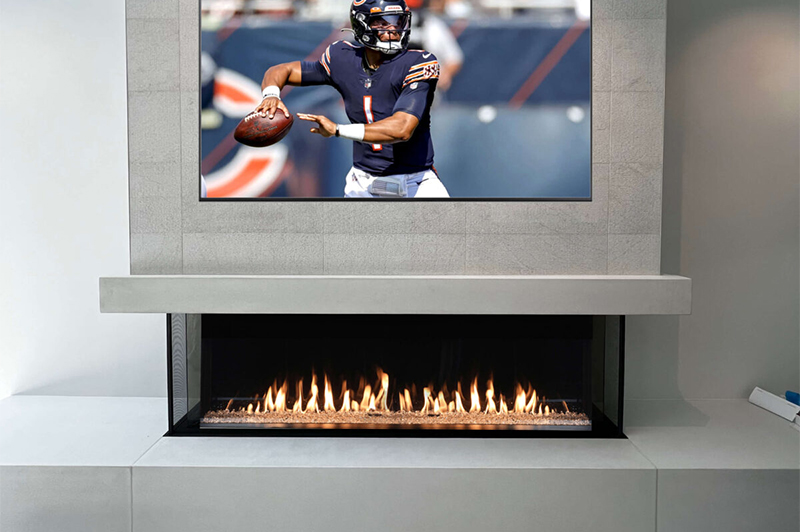
Beyond width, glass height, and media, the detail that matters most on a corner unit is heat management, because the fireplace is flanked by walls or built-ins on two sides rather than one. Cool Touch Wall helps manage heat around the fireplace wall and can support more flexible finish options when installed according to Flare’s installation manual, heat release requirements, and project-specific specifications. The Active Heat Flex System gives designers control over how heat exits the unit. For corner-specific planning, see Installation Mistakes to Avoid with Frameless Fireplaces. To pull exact dimensions, clearances, and framing details for a specific model, use the Flare Spec Tool.
Frequently asked questions
Can a corner fireplace be used as a room divider?
What glass height should I choose for a corner fireplace?
Can a corner fireplace be used outdoors?
What is the clearance to combustibles in front of the short side of the glass?
Get a quote for your corner fireplace
Tell us about the space and the configuration you have in mind. A member of the Flare team will come back with sizing, specifications, and pricing for your project.
- Response within one business day
- No obligation to request a quote
- Speak directly with our team: 1-866-639-1590
Turn the corner into the centerpiece.